


UV researcher promotes collaboration with the University of Tokyo
9/11/2025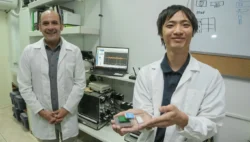
Dr Alexies Dagnino with Takumi Yamasaki, doctoral student at the University of Tokyo
UV PRESS / Dr Alexies Dagnino, an academic at the Institute of Physiology and lecturer on the Master’s Programme in Neuroscience at UV, is leading a scientific partnership with Japanese researcher Yasushi Kiyokawa. This partnership combines the use of a wireless technology that is unique in the Southern Cone with the study of pheromones that promote stress resilience.
An innovative scientific collaboration is bringing together the Stress Neurobiology Laboratory at the Universidad de Valparaíso and the University of Tokyo. The aim is to decipher the brain mechanisms that promote resilience to stress. Led by Dr Alexies Dagnino, who is a researcher at the Institute of Physiology and CIESAL, as well as a lecturer on the Master’s and Doctoral programmes in Neuroscience at UV, the project arose from Professor Yasushi Kiyokawa’s interest in the advanced wireless technology used in Dr Dagnino’s laboratory at the Universidad de Valparaíso.
This technology is unique in the Southern Cone and is found in only a few laboratories worldwide that study stress. It enables the recording of brain activity during social behaviour in real time without the use of wires. “Put simply, we can record what happens in the brain when animals interact socially. This gives us an unprecedented insight into how neural activity is organised under natural behavioural conditions,” explains Dr Dagnino.
The link between the two researchers was forged during an international neuroscience conference held in Panama. “I led a symposium on stress and depression there and met Professor Kiyokawa. He told me that his laboratory had discovered pheromones that promote resilience to stress, which I found fascinating as our research focuses on the brain mechanisms that generate it. When he learned about our technology, he became interested in finding out more and suggested we collaborate,” Dagnino recalls.
He adds that “the research centre where Professor Kiyokawa works at the University of Tokyo does not have this technology, but they have significant engineering and biotechnology developments that are closely connected to industry to generate applied research. We thought we could teach them how to use it, and they could then improve upon it. That is how this collaboration between our laboratories came about”.
A valuable alliance
Thanks to a Japanese funding project aimed at promoting joint research between the two countries, the partnership was formalised when Takumi Yamasaki, a PhD student from Kiyokawa’s laboratory, arrived in Valparaíso to undertake a three-month internship at UV’s Stress Neurobiology Laboratory in order to learn how to use this innovative technology.
“It’s a very valuable experience, especially in the field of electrophysiology. In Japan, there are large laboratories with advanced infrastructure, but here, despite the smaller spaces, I have seen that there is significant technical capability, and a highly skilled team. That has impressed me a lot,” said Yamasaki, adding: “The people in Valparaíso are very kind and friendly. I have felt very welcome.”
For Dr Dagnino, Yamasaki’s presence marks the first step in a collaboration that promises to extend over several years. “This is a very complementary research project. They are studying how certain pheromones promote stress resilience, which in humans could be compared to empathy, and we are seeking to understand how these processes are generated within the brain. If we manage to integrate both perspectives, we could open new therapeutic avenues and even develop a future ‘antidepressant pheromone’,” he suggests.
The researcher also points out that UV is the only institution in Latin America that uses this technology to study stress and resilience, from Mexico southwards. “We have a wireless system that allows us to record neuronal activity and synchronise it with behaviour in animal models on a millisecond scale. It’s like listening to the neurons as behaviour emerges from the brain. This puts us at a very competitive level internationally,” he says.
The collaboration also envisages future visits for Chilean academics and students to the University of Tokyo, as well as joint participation in high-level conferences such as the Japanese Society for Neuroscience conference, which is one of the most prestigious events in the field. “We want this relationship to be long-term because it also aligns with the Universidad de Valparaíso’s internationalisation policies,” adds Dagnino.
Diversity of perspectives
The researcher explains that resilience to stress is not solely dependent on biological factors but is also deeply influenced by culture. “The way we deal with stress is related to what we eat, what we think, and how we feel. These elements, which are specific to each culture, all influence our ability to adapt and withstand difficult situations,” he says. He highlights that collaborating with Japanese researchers provides a valuable complementary perspective. “We observe the phenomenon of resilience from the southern hemisphere with a Latin American perspective, while they observe it from an oriental perspective. These different ways of understanding resilience greatly enrich the research.”
The academic emphasises that this international collaboration enables a broader range of approaches to be adopted in the study of stress. “For a long time, the most widely used models have come from Europe or the United States. Incorporating perspectives from other regions of the world, such as Latin America and Asia, introduces diversity, which is fundamental to science. It enables us to answer questions more comprehensively and provide new insights that benefit the entire scientific community,” he says.
Along these lines, Dr Dagnino emphasises that both Chile and Japan face a common challenge in the form of the impact of stress on mental health. “In both countries, rates of stress-related illness are very high. This is why this collaboration makes profound sense — to seek solutions from different cultural realities for a global problem,” he concludes.
Text: Pamela Simonetti / Photos: Denis Isla